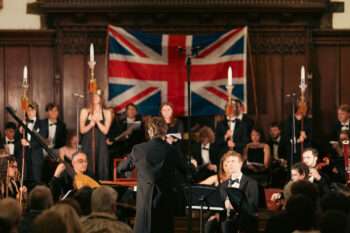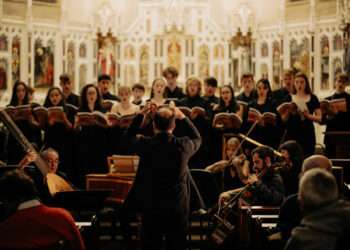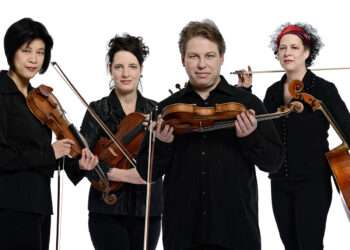

Opera in Venice was, and is, closely associated with the city’s lavish carnival season, so it was perfect timing for us in Durham that Musica Antica Rotherhithe’s touring programme of seventeenth century Venetian rarities ‘La decima musa’ should come to us for a MUSICON concert at the climax of the carnival on Shrove Tuesday.
In his comprehensive programme notes and spoken introduction, the ensemble’s director (and Durham alumnus) Dr Oliver Doyle explains that Venice in 1637 was the first place ever where any member of the general public could attend an opera by simply turning up and buying a ticket; previously, opera had been exclusively the preserve of the aristocracy at private court performances.
Musica Antica Rotherhithe’s programme drew on the operas written for these public performances by Francesco Cavalli, Barbara Strozzi, GIovanni Legrenzi, Francesco Lucio and Pietro Andrea Ziano. Doyle did a quick show of hands to see which names were familiar to us: Cavalli and Strozzi yes, Legrenzi possibly, but not the other two.
By way of an overture, the ensemble gave us three darkly elegant dances by Cavalli and Legrenzi. The combination of instruments was chosen based on research into the theatre account books (in academia, as in detective work, follow the money!), supplemented by eye-witness accounts, which gave them justification, if any were needed, for a luxury casting of three theorbos. This gave a delicious bass line, and the contrast of their resonant plucked strings set beneath the legato bowing of the two violins created an unusual and beautiful texture.
Doyle explained that the composers we were hearing had moved away from the earlier operatic conventions of one solo voice following another, and began to introduce dialogue into their music, and this was illustrated across the programme in operatic duets and solos sung by the gorgeously matched voices of mezzo-soprano Camilla Seale and countertenor Tristram Cooke.
Both singers had a pure, straight tone that was well suited to this repertoire, and with similar ranges, they entwined together very seductively. After a rapturous opening duet Mia Speranza (‘My hope’) from Cavalli’s L’Elena, the texts were mostly discourses on lovers’ torments of one sort or another, which even without any knowledge of the individual opera plots, made for a narratively coherent programme – complete with a happy ending as the final aria celebrated the joys of a shared bed.
A long dialogue by Ziani from La fortuna di Rodope e Damira gave both singers scope for dramatic characterisation and colour, with some naughty note-bending in the characters’ sarcastic asides. (In true operatic style, Cooke was singing the role of a woman disguised as a man at this point). However, it was clear without needing to read their programme biographies which of the two singers is more accustomed to the opera stage: Camilla Seale physically inhabited each character, at times singing to the audience with arresting directness and at other times trying to interact with Tristan Cooke, who mostly kept his expressiveness strictly within his voice.
A glance at the Rotherhithe tour page shows that the group have been carefully varying their programme so that each venue is treated to a modern premiere – the Ziani duet had had its first outing the day before in Oxford and tonight it was the turn of a secular cantata Se laggiù ne gl’abissi by Cavalli, sung by Seale. The first section really showed off her rich timbre and range of colour before the mood switched to a lovely sad stillness that completely absorbed us. Seale also held the audience completely spellbound, spinning out long legato lines in Barbara Strozzi’s ‘Udite amanti’ (‘Hear, lovers’), accompanied just by Jonatan Bougt’s theorbo: one of the most magical moments of the evening.
Things got livelier after this with the turbulent ‘Da amorose passione’ from Lucio’s Il Medoro in which one lover complains that a rough sea is calmer than a woman and both singers got completely caught up in the flirtatiousness, with Seale finally getting a reaction out of her partner whilst the instruments bounced off each other in a stormy accompaniment. The lovers in Musica Antica Rotherhithe’s drama were finally united in Cavalli’s ‘Un talamo ed un letto’ (One chamber and one bed) bringing this fascinating and gorgeously performed evening to a triumphant close. If, like the baroque Venetians, I had to give up opera for Lent, this would have been a suitable final feast before the fast.
It was also a cheap feast, thanks to MUSICON’s policy of keeping ticket prices low, and in this case, the support of that excellent organisation the Continuo Foundation which supports performances of early music across the country. In past years, I’ve written about being disappointed about attendance at MUSICON concerts, but this season, Durham’s audience is turning out in force – if this continues, I’ll have to abandon my habit of turning up to buy a ticket on the door.
If you missed this concert and perhaps have had your appetite whetted by reading this, Musica Antica Rotherhithe will be releasing a recording of their tour material later this year. See musicaantica.org.uk